 Hotel search
 Call now

 Write by Whatsapp
 Write by E-mail



Or write to us:
By pressing send button I declare that I have read and understood the information on the processing of my personal data provided by Travellero (View)
Getting Around Uzbekistan Between Cities and Regions
Summary
- Travelling by train in Uzbekistan
- Afrosiyob: the fast train between the main cities
- Tashkent, Samarkand and Bukhara: when the train makes sense
- And how do you get to Khiva?
- Taxis in Uzbekistan: particularly useful in cities
- In Tashkent, the metro is a real alternative
- Buses: when they can be useful
- When a domestic flight makes sense
- Transfers with a driver for less connected areas
- Renting a car: do you really need one?
- The best means of transport changes during the journey
- Before departure: three checks that can prevent problems
- How to organise transport without complicating the journey
Getting around Uzbekistan is easier than the distances on a map might suggest. The country is vast, and some cities are hundreds of kilometres apart, but along the most travelled routes the available connections make it possible to plan a journey without necessarily relying on a car.
The key is choosing the right means of transport for each leg of the journey.
Trains work particularly well between several major cities; taxis and public transport are useful once you reach your destination; for the west of the country or areas far from the railway network, a domestic flight or road transfer may make more sense.
Understanding how to get around Uzbekistan therefore means, above all, avoiding the idea that the same solution will work throughout the entire journey.
Travelling by train in Uzbekistan
For anyone moving between the country's main cities, rail is one of the first options worth considering.
Uzbekistan's railway network reaches numerous destinations and connects, among others, Tashkent, Samarkand, Bukhara, Khiva, Urgench, Navoi, Nukus, Karshi and Termez.
Not all trains, however, are the same.
Alongside faster services, conventional trains operate with longer journey times and may offer different types of accommodation. Two options that appear similar on a map can therefore provide quite different travel experiences in terms of both duration and comfort.
When searching for a ticket, it is worth checking the type of train as well as the departure time.
There is also a very practical consideration: on the most popular routes, waiting until the last minute can considerably reduce the choice available. If a particular departure is important for keeping the rest of the itinerary on schedule, buying the ticket in advance can prevent having to rearrange subsequent stages of the journey.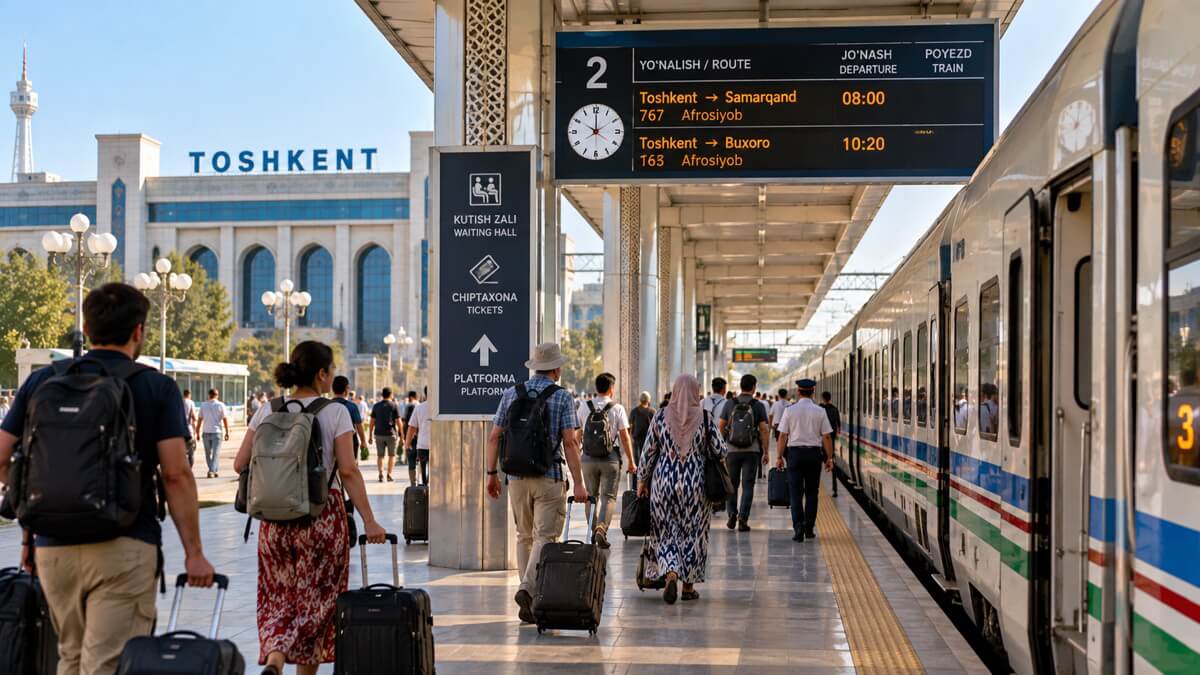
A journey through Uzbekistan can begin by rail: from Tashkent, train connections make it possible to reach some of the country's main cities, combining them with taxis, public transport and road transfers.
Afrosiyob: the fast train between the main cities
The name that comes up most often when discussing trains in Uzbekistan is Afrosiyob.
This high-speed rail service operates on some of the country's most important routes and makes travelling along the Tashkent-Samarkand-Bukhara corridor particularly convenient.
For travellers, the difference is most noticeable when planning the day. A fast rail connection makes it possible to move from one city to another without necessarily turning the transfer into an entire day of travelling.
This is precisely why seats can be in high demand.
It is better to check availability and timetables when setting the dates of the trip rather than assuming that the same service will operate every day under identical conditions.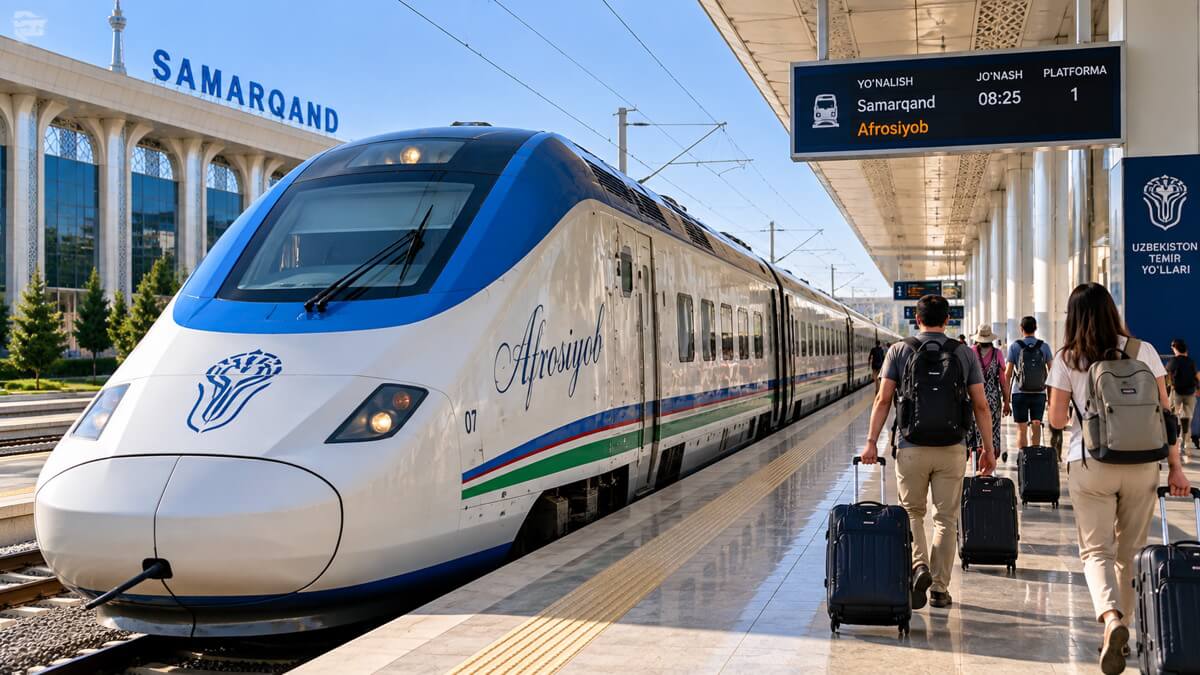
After departure, the Afrosiyob comes into play on the main railway routes, providing a high-speed service that makes travel between some of Uzbekistan's major cities faster.
Tashkent, Samarkand and Bukhara: when the train makes sense
Looking at the geography of the journey, Tashkent, Samarkand and Bukhara form a route where rail travel becomes particularly useful.
It is possible to leave the capital, reach Samarkand and then continue towards Bukhara without having to arrange a long road transfer each time.
The journey should, however, be considered as a whole.
The time printed on the ticket only covers the train journey itself. You also need to allow for the transfer from the hotel to the station, arrive with sufficient time before departure and, once at the destination, travel onwards to the next accommodation.
These may seem like minor details, but on travel days they can make the difference between a realistic itinerary and one built around timings that are simply too tight.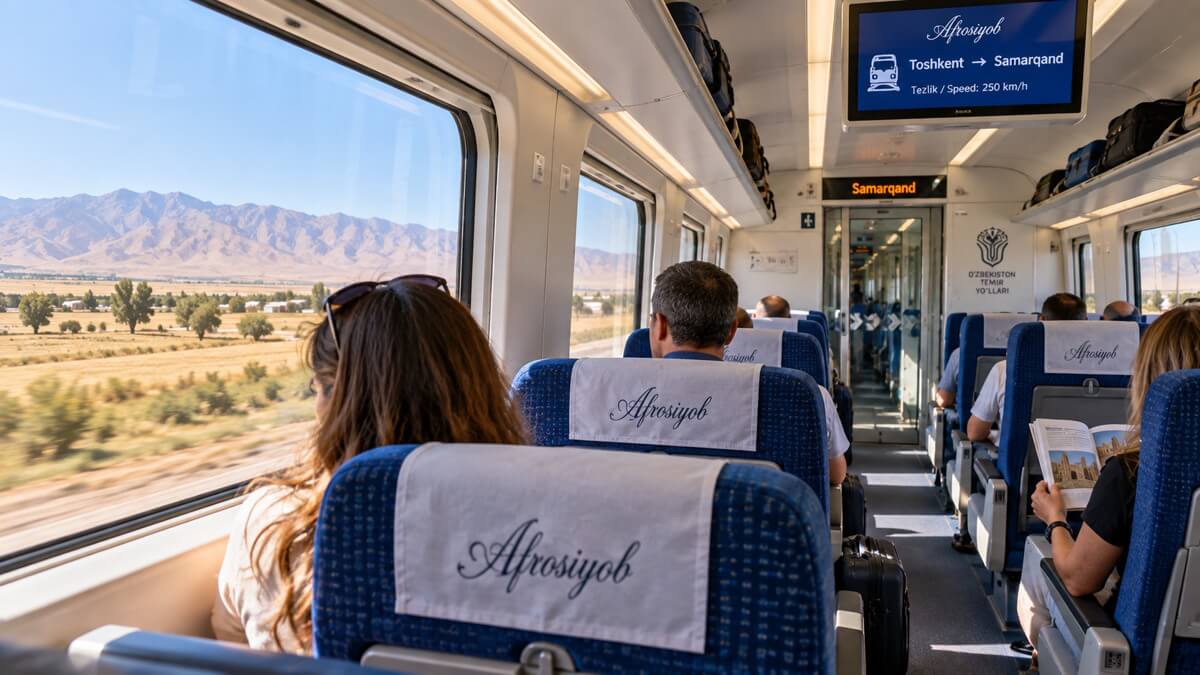
Leaving Tashkent behind, the journey continues aboard the Afrosiyob as the Uzbek landscape passes by beyond the windows, providing fast connections between some of the country's main cities.
And how do you get to Khiva?
Khiva changes the picture.
The city lies much farther west than the Tashkent-Samarkand-Bukhara corridor, and the distance itself is a good reason to compare several options before deciding.
The railway network allows travellers to search for connections to Khiva and nearby Urgench. Depending on the departure city and date, however, a road transfer or domestic flight via Urgench Airport may also be worth considering.
Here, the comparison should not be based on price alone.
A connection that appears faster may require additional time to reach the airport, complete departure procedures and continue to Khiva after landing. A longer train journey, on the other hand, may have the advantage of avoiding some of these intermediate steps.
It is therefore more useful to consider the total door-to-door travel time.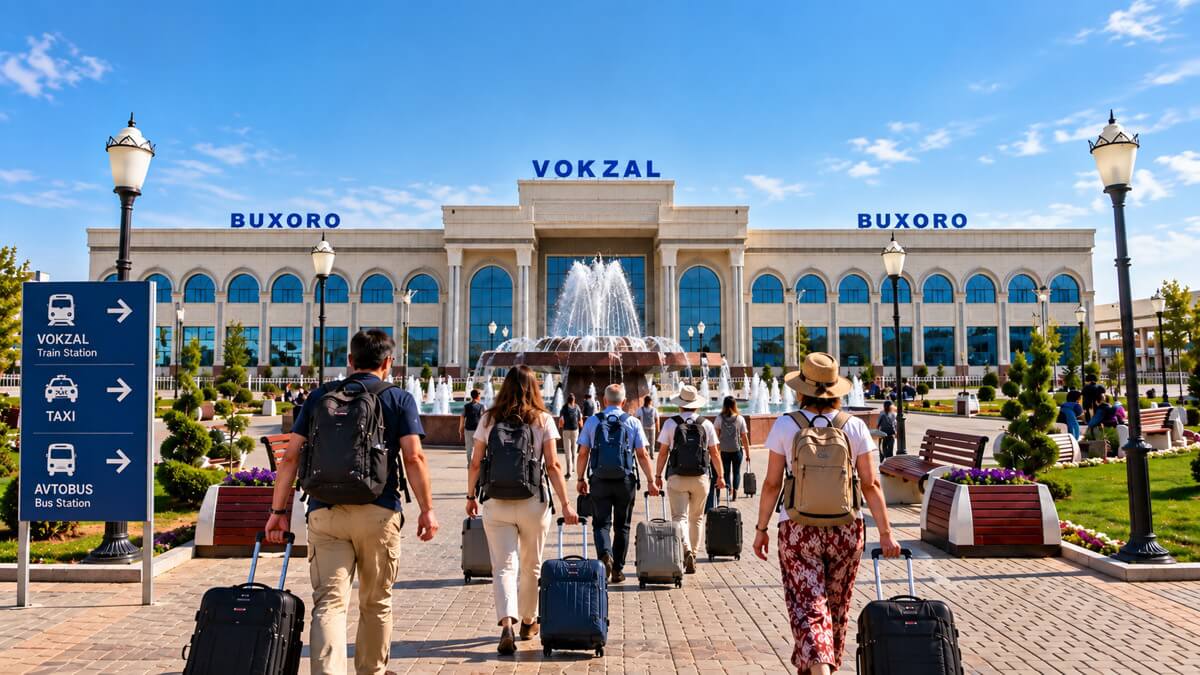
Continuing west, the distances become greater and the travel options also change: to reach Khiva, travellers can consider rail connections, road transfers or flights via Urgench.
Taxis in Uzbekistan: particularly useful in cities
Once you step off the train, the nature of the journey changes completely.
Taxis in Uzbekistan are a practical way to travel between railway stations, airports, hotels and parts of a city that are not easily reached on foot.
In the main destinations, taxi services can also be booked through smartphone apps. For first-time visitors, this has an obvious advantage: the destination can be entered directly into the app and the conditions of the journey are generally clearer.
It is a simple detail that can also remove many of the difficulties caused by language differences.
When taking a taxi directly from the street, however, it is sensible to clarify the fare or how it will be calculated before setting off.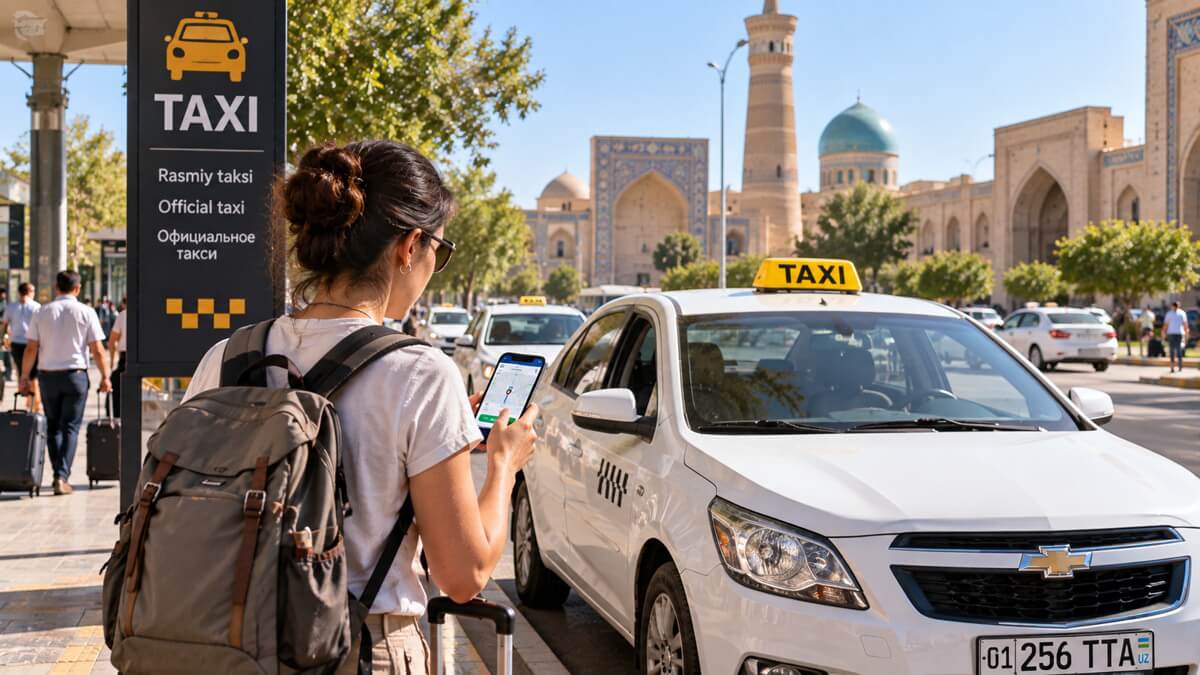
Once in the city, taxis are a practical option for continuing to hotels, stations and other urban areas; in the main destinations, services that can be booked via smartphone are also available.
In Tashkent, the metro is a real alternative
Tashkent deserves separate consideration because it has its own metro network.
For travelling around the capital, the Tashkent Metro can be extremely useful: it connects different parts of the city without relying entirely on road traffic and can easily be combined with short taxi or bus journeys.
The stations have also become known for their architecture and decorations, but from a practical point of view they remain, first and foremost, part of the capital's everyday transport system.
Before travelling, it is advisable to check current lines, operating hours and payment methods, particularly if a significant amount of time has passed since the trip was originally planned.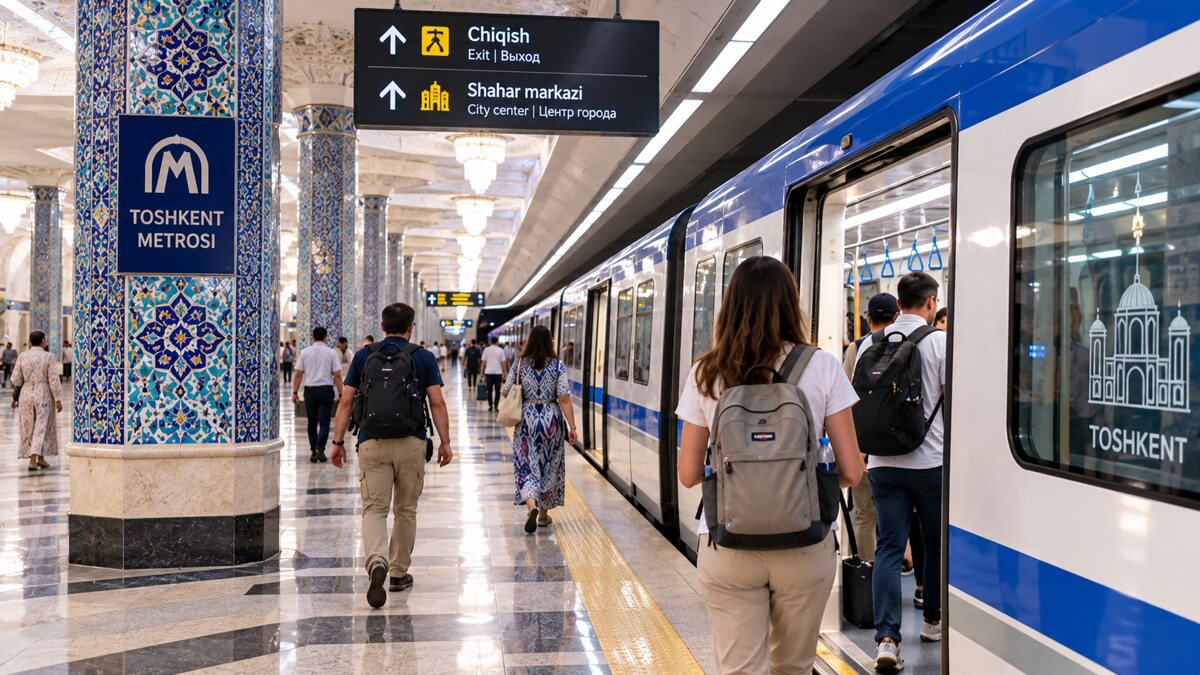
In the capital, the journey continues underground: the Tashkent Metro makes it easy to travel between different areas of the city and can be combined with taxis and buses to reach the final destination.
Buses: when they can be useful
Buses are part of everyday urban mobility in Uzbekistan and provide an economical alternative for many journeys.
For someone unfamiliar with the city, however, immediately understanding stops and routes may require a little more attention than using a taxi or the metro.
That does not mean buses should be avoided. On the contrary, they can be useful when the route is straightforward or when a reliable mapping app is available on your phone.
Bus connections also operate between different cities. In this case, they become another option to compare with rail travel, particularly when the destination is not conveniently served by train.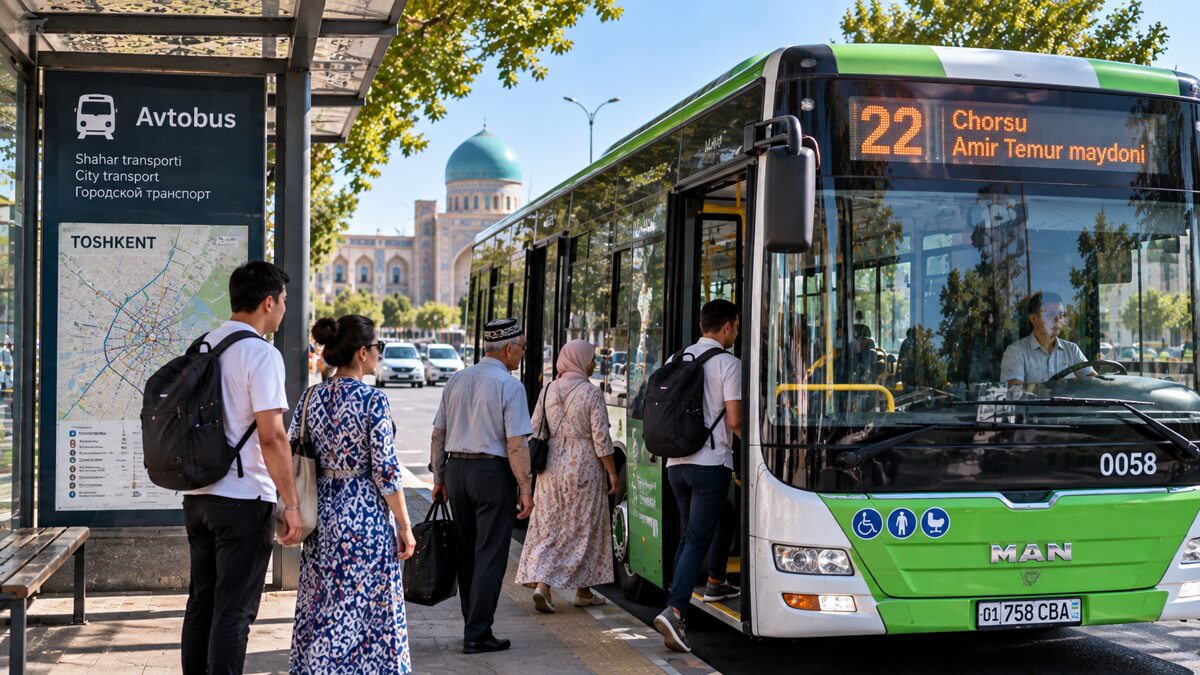
After leaving the metro, the journey can continue above ground: buses connect different areas of Uzbekistan’s cities and provide a practical alternative for routes served by public transport.
When a domestic flight makes sense
The sheer size of Uzbekistan becomes particularly apparent when an itinerary includes places at opposite ends of the country.
In these situations, a domestic flight can radically reduce travel times.
Before booking, however, the same principle applies as with other forms of transport: consider the entire transfer, not just the flight time.
Reaching the airport, completing departure procedures, collecting luggage and continuing to the hotel all take time. Over very long distances, flying can still offer a clear advantage; on shorter routes, comparing the total journey with the train may produce a different result.
Flight frequencies and schedules can also change, so they should always be checked for the actual travel dates.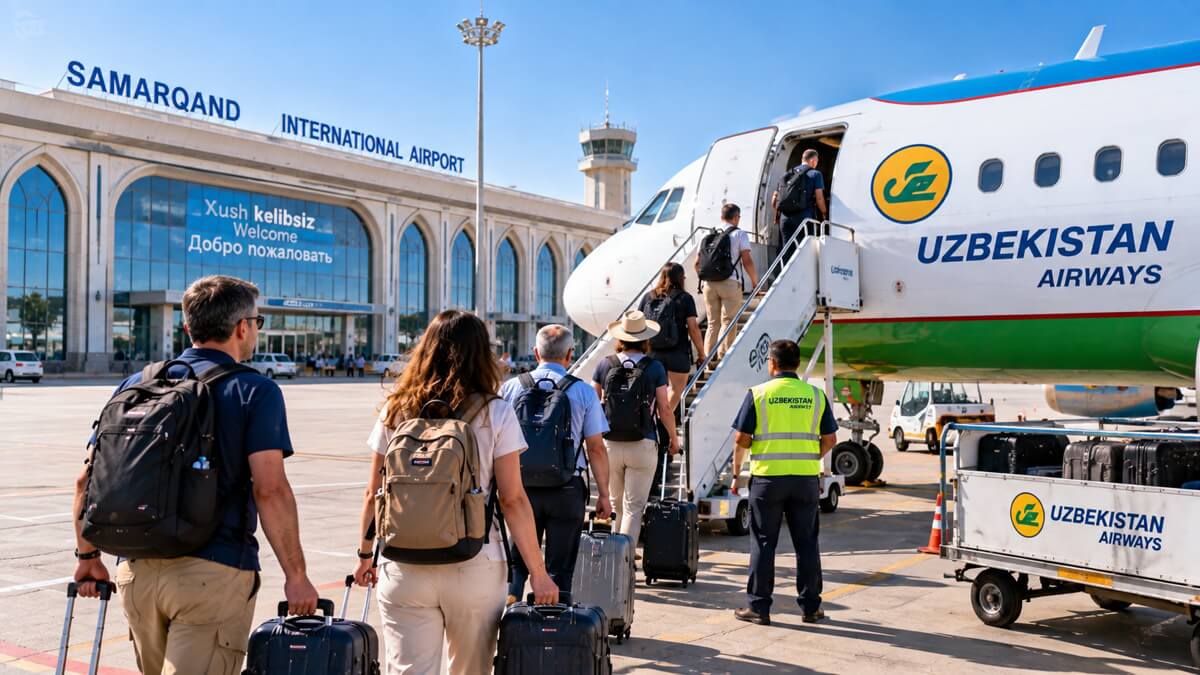
When distances increase, the journey can continue by air: domestic flights connect different regions of the country, reducing travel times on longer routes compared with travelling overland.
Transfers with a driver for less connected areas
Not every journey through Uzbekistan follows a railway line.
When travelling away from the main cities, a car with a driver or an organised transfer can become the most practical solution.
This is particularly true for routes through rural areas, small villages or natural landscapes where using several forms of public transport in a single day would make the journey unnecessarily complicated.
The advantage is not simply comfort. Having a vehicle available allows the transfer to be organised around the places actually included in the itinerary rather than structuring the entire day around public transport timetables.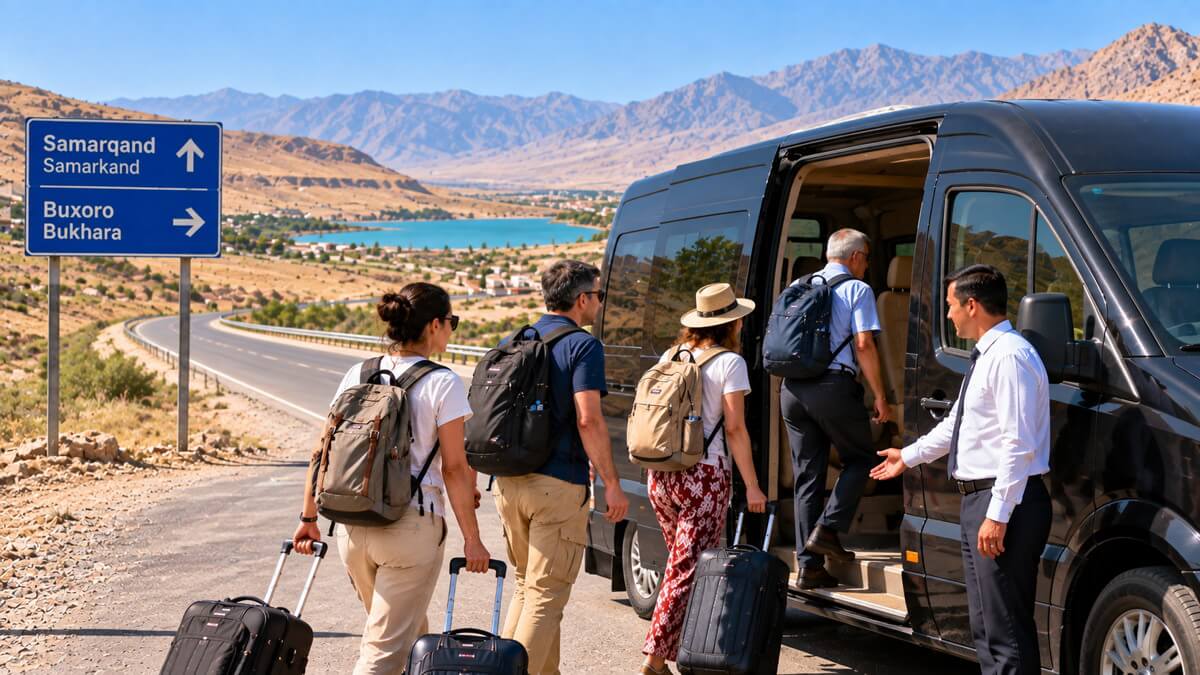
Away from the main railway routes, the journey can continue by road: cars and minivans with drivers make it possible to reach rural areas and destinations with fewer public transport connections.
Renting a car: do you really need one?
Car rental is an option, but before choosing it, it is worth considering how much the vehicle will actually be used.
If the journey focuses mainly on cities connected by rail, combining trains and taxis may be easier than managing a rental car throughout the entire stay.
Having your own vehicle becomes more useful when the itinerary includes less accessible destinations or when greater independence is a priority.
Traffic in Uzbekistan drives on the right. Before booking, travellers should check directly with the rental company which driving documents are required, what insurance conditions apply and what rules govern the vehicle.
The best means of transport changes during the journey
One of the easiest mistakes to make is looking for a single answer to the question of the best way to travel around Uzbekistan.
In reality, the answer keeps changing.
A train may be ideal for reaching Samarkand; a taxi may solve the transfer from the station to the hotel; the metro may be convenient during a day in Tashkent; a car with a driver may make more sense once the railway network is left behind; and a domestic flight can save many hours when distances become particularly long.
It is precisely the combination of different forms of transport that makes organising the journey easier.
Before departure: three checks that can prevent problems
The first is to check exactly where railway stations and airports are located. Having the name of the city on the ticket does not necessarily mean the departure point is close to the hotel.
The second is to double-check the date, departure time and station shown on the train ticket. When several services operate on the same day, confusing one departure with another can easily disrupt the stages that follow.
The third concerns internet access. Having a data connection on your phone is particularly useful when travelling independently: it allows you to consult maps, search for addresses, use taxi apps and check for changes.
These are simple precautions, but once on the road they are often more useful than trying to memorise a long list of information before departure.
How to organise transport without complicating the journey
To get around Uzbekistan, there is no need to choose a single means of transport in advance and use it everywhere.
It is more effective to divide the itinerary into individual journeys.
First identify the cities that need to be connected, then check whether there is a suitable train. Where rail is not convenient, compare road and air options. Once inside the cities, taxis, the metro and buses come into play.
In this way, transport stops being a separate part of the trip and simply becomes the connection between one stage and the next.
One rule remains essential: timetables, fares, frequencies and purchasing procedures should always be checked through official channels before departure, as they may change over time.
Travellero Club
Join our community to access:
 Special rates
- Exclusive benefits and freebies
- Additional discounts
- Accumulate holiday points

Get the Travellero Club discount now
By pressing "Join the club" I declare that I have read and understood the information on the processing of my personal data provided by Travellero (View)